

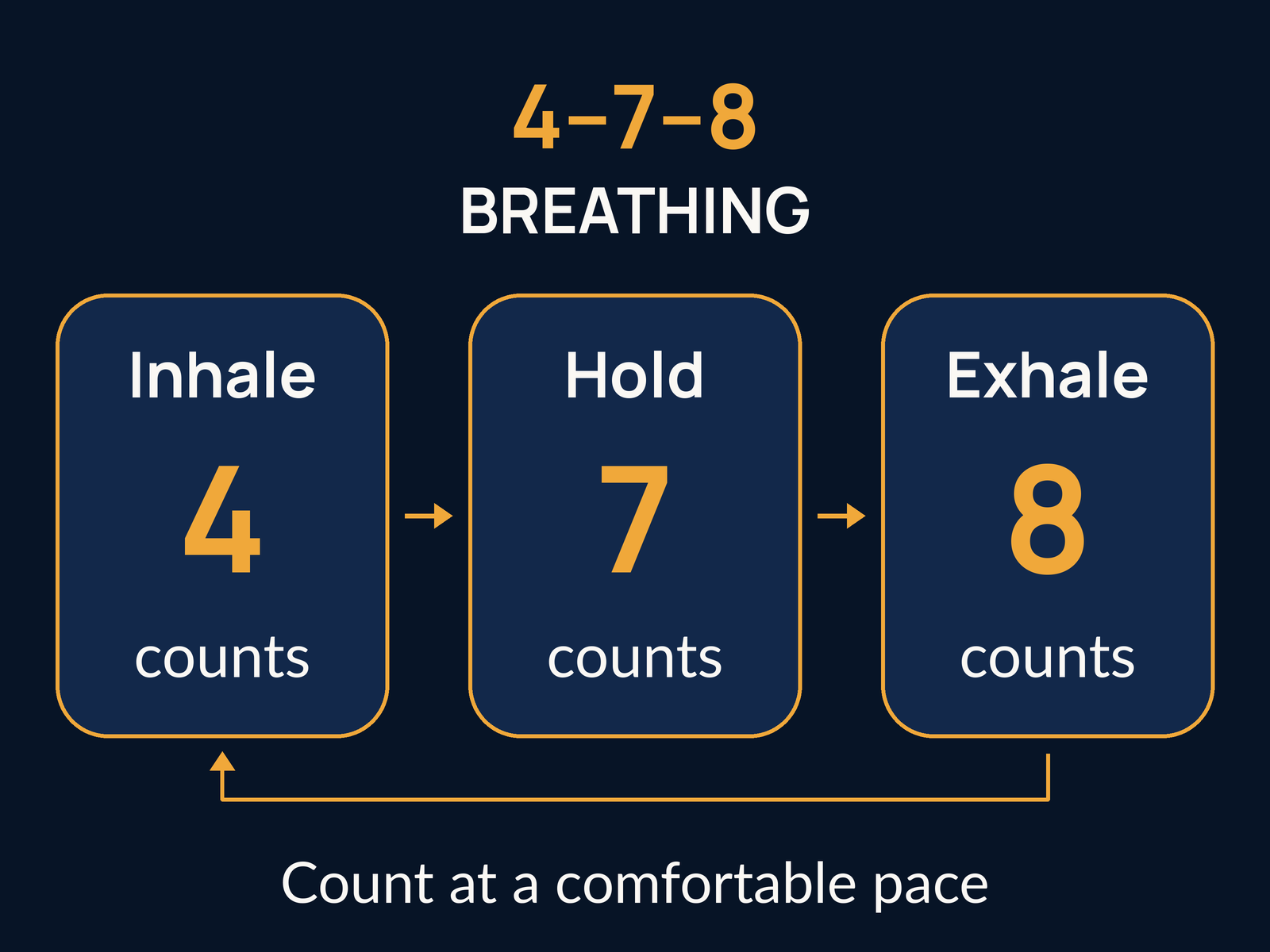
Some evenings, the day has ended but your mind is still working through it. The 4-7-8 breathing method gives you a simple rhythm to follow: breathe in for four counts, hold for seven, and breathe out for eight.
This guide explains how to follow the pattern at a comfortable pace, what to do if the hold feels difficult, and how to make room for a short breathing pause in your day.
Start with a comfortable breath
Sit in a supportive chair with your feet resting on the floor. Let your shoulders settle and loosen your jaw. Take a few ordinary breaths before you begin. Choose a moment when you can safely give the exercise your attention.
Keep your breathing gentle. Avoid taking an unusually large breath or pushing through a difficult hold. If you feel dizzy, breathless, or more anxious, stop and return to your usual breathing. Get medical advice for symptoms that persist or concern you.
If you have a heart or breathing condition, or you are unsure whether breath-holding is suitable for you, check with your healthcare professional first. This guide supports general wellbeing and does not replace medical care. The British Heart Foundation’s breathing guidance includes advice on practicing safely.
What is the 4-7-8 breathing method?
The 4-7-8 method is a breathing exercise with three stages: an inhale, a gentle hold, and a longer exhale. One sequence completes a round. There is no additional hold after breathing out.
The numbers describe counts, rather than a required number of seconds. Keep an even counting pace across all three stages. A seven-count hold should not become a test of how long you can go without breathing.
You can follow the sequence silently in your mind. The diagram and demonstration below show the order, while the written steps let you practice away from the screen.
Practice the 4-7-8 rhythm
Use one consistent counting pace that feels manageable. Watch the demonstration first if helpful, then follow your own comfortable rhythm. The animation shows an example pace; you do not need to match its timing.
How to do 4-7-8 breathing method
- Sit comfortably. Rest the tip of your tongue lightly against the ridge behind your upper front teeth.
- Let a breath out through your mouth before starting the count.
- Close your mouth and inhale through your nose for four counts.
- Hold gently for seven counts, keeping your face and shoulders relaxed.
- Exhale through your mouth for eight counts, making a soft whooshing sound.
Complete up to four cycles while comfortable, following Cleveland Clinic’s 4-7-8 instructions. You can stop sooner. After your last round, let your breathing return to its natural rhythm.
Comfort tip: If the hold makes you strain or feel short of breath, stop. There is no need to finish the count. Choose an exercise without holds if that feels easier.
If the seven-count hold feels difficult
Return to ordinary breathing first. When you feel comfortable, you can try a gentle inhale followed by a gentle exhale, with no deliberate pause between them. Count only if it helps you keep the breath easy.
The NHS breathing exercise for stress offers an unforced approach without a breath hold. Our guide to five breathing exercises to calm your mind also includes belly breathing and equal breathing.
These are different exercises, so you do not need to preserve the 4-7-8 pattern when choosing one. Let comfort guide the choice. If focusing on your breath adds tension, take a break from the exercise altogether.
When to try 4-7-8 breathing method
Choose a quiet moment when you have room to pause. You might place the practice:
- After finishing work: close your laptop, put your phone aside, and settle into a comfortable seat before beginning.
- During an evening transition: use the time between completing a task and starting something else as a reminder to pause.
- As part of winding down: try a few comfortable rounds before bed, then continue with the rest of your evening routine.
Notice how the practice feels without needing a particular outcome. You might feel more settled, or you might prefer another rhythm. Finding an exercise that suits you can take a little experimentation.
How 4-7-8 breathing may help
A repeated count gives your attention a simple sequence to follow. Some people find this helpful when thoughts feel busy or they want to settle into a quieter activity.
Research on the 4-7-8 method itself is limited, as the British Heart Foundation explains. It is reasonable to explore it as a relaxation practice, but it should not be presented as a proven treatment for insomnia or an anxiety disorder, or as a promise of sleep within a certain number of seconds.
More broadly, the NCCIH overview of relaxation techniques describes potential benefits alongside limits in the evidence. If sleep difficulties or anxiety keep affecting your everyday life, speak with a qualified healthcare professional.
Make room for a quiet pause
Give the practice a small, familiar place in your day. You could try it after brushing your teeth or before opening a book in the evening. Start with a few comfortable rounds and notice whether you want to return to it.
When you finish, let the counting fall away. Rest for a moment, then move on with your day or evening. Explore our breathing guides whenever you would like to try another approach.
Frequently asked questions
Do the counts need to be exact seconds?
No. Use a steady counting pace that feels comfortable. Keep that pace consistent through the inhale, hold, and exhale. The 4-7-8 ratio describes the pattern; it does not require a seven-second breath hold.
How many rounds should I start with?
Begin with up to four comfortable rounds. Stop earlier if you want to, then breathe normally. You do not need to keep repeating the exercise until you feel calm or sleepy.
Can 4-7-8 breathing help me fall asleep?
Some people find it useful for winding down. It cannot guarantee sleep, and research on this specific technique is limited. If you regularly struggle to sleep or feel tired during the day, seek advice about the underlying problem.
What if I cannot comfortably hold my breath?
Stop the counted exercise and return to normal breathing. You can choose belly breathing or gentle, even breathing without holds instead. Finishing the pattern is never more important than feeling comfortable.
How is it different from box breathing?
The box breathing technique uses four equal stages: inhale, hold, exhale, and hold again. The 4-7-8 method has three stages, with different counts and no final hold. Either pattern can feel demanding if you dislike breath-holding, so a continuous breathing exercise may suit you better.