

A daily breathing habit gives you a regular moment to pause, notice how you feel, and practice a familiar exercise. You can begin with one comfortable minute at a point in your day that already happens.
This guide helps you choose a reminder, keep the practice manageable, and return after interruptions. Use the first week to discover what fits your life, without expecting every session to feel calm.
What makes a breathing practice easier to repeat?
Decide three things in advance: when you will begin, where you will sit, and what you will do. A clear plan saves you from choosing a new exercise or finding the perfect moment each day.
The NHS breathing guide recommends regular practice as part of a daily daily breathing habit routine. The short sessions suggested here help you organize that practice. Their duration is a starting suggestion to adapt to your comfort and any individual guidance you have received.
1. Choose one reliable daily cue
A cue is something that reminds you to begin. Pick an event you already recognize in your day, then decide exactly what you will do after it.
- After clearing your breakfast plate: sit in your usual chair for a brief breathing pause.
- Before your first work task: settle at your desk and practice before opening your messages.
- After your evening wash: sit comfortably for a short practice before continuing your bedtime routine.
Choose one of these, or an equally familiar moment. Write your plan in a sentence: “After I put my breakfast plate away, I will sit in the kitchen chair and practice for one minute.”
If your hours change from day to day, choose an event rather than a clock time. Check that your cue also makes sense on days off. This is a practical application of research on repeating a behavior in a consistent context, rather than a breathing-specific habit formula.
2. Give yourself a small starting version
For your first few sessions, set aside about one minute. If that feels manageable, you can gradually make more room for the practice. There is no need to increase the time every day.
Also decide what you will do when the day becomes crowded. Your shorter version might be sitting down, relaxing your shoulders, and noticing three ordinary breaths without changing them.
The shorter version keeps the starting point manageable; its purpose here is to help you remember the pause. If you are following a clinician’s breathing plan, keep their instructions.
3. Practice gentle belly breathing
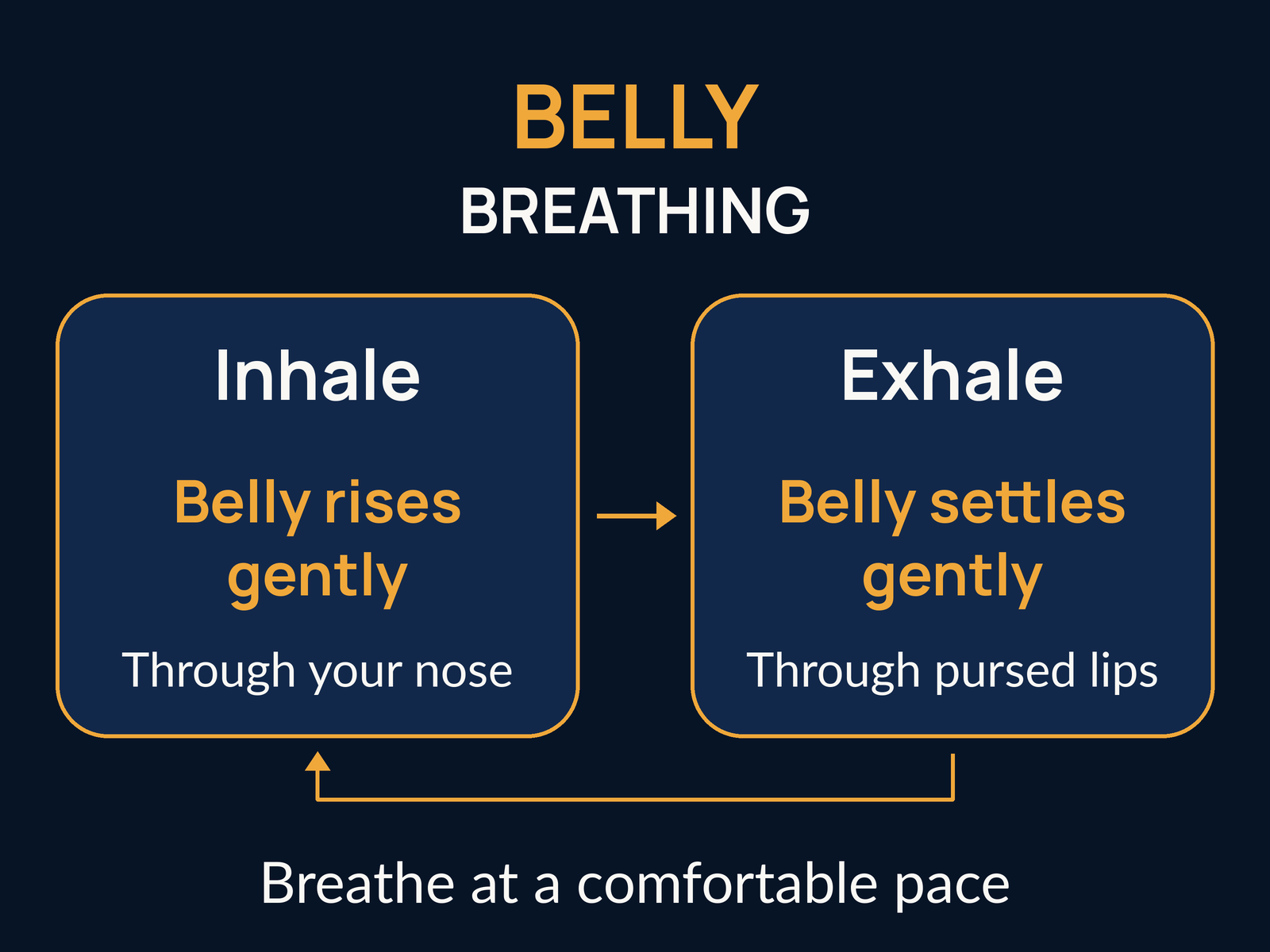
Start with one familiar exercise so that the routine stays simple. Belly breathing offers a way to notice gentle movement below your ribs without adding a timed breath hold.
How to do it for a daily breathing habit
- Sit in a supportive chair with your feet resting comfortably and your shoulders relaxed.
- Rest one hand on your upper chest and the other just below your ribs.
- Inhale gently through your nose. Notice your lower hand rise slightly; avoid taking a very large breath.
- Exhale through softly pursed lips, letting your belly settle. Keep the movement easy and unforced.
- Continue at your own comfortable pace for about a minute, then let your breathing return to its usual rhythm.
The hand placement follows Cleveland Clinic’s diaphragmatic breathing guidance. The video demonstrates the movement; you do not need to match its timing. Other options are explained in our guide to five breathing exercises.
Comfort tip: Stop if you feel dizzy, short of breath, or uncomfortable, and return to ordinary breathing. Seek medical advice for unexpected or persistent symptoms. If you have a condition affecting your breathing, ask your healthcare professional which exercises suit you. The British Heart Foundation’s safety guidance also recommends stopping for concerning symptoms.
4. Prepare a space and a simple reminder
Choose a place you can use without rearranging your home. An ordinary chair is enough. Leave the instructions nearby if you need them, and decide whether you prefer quiet or a visual demonstration.
Use one reminder initially: a small note beside your notebook, a calendar entry, or a phone alert. Give it a specific label, such as “One minute in the kitchen chair.” If you keep dismissing it, change the timing or location before adding more reminders.
A flexible seven-day starting plan for a daily breathing habit
Use this first week to try out your routine. This is an example schedule for testing the setup; habit formation can take much longer than seven days.
- Day 1 — Choose your plan. Write down your cue, place, and one-minute practice. Try it once in that setting.
- Days 2 and 3 — Repeat the setup. Return after the same cue. Keep the session short while you learn the sequence.
- Days 4 and 5 — Notice the obstacle. Was the chair unavailable? Did the reminder arrive during a meeting? Adjust the practical detail that made starting difficult.
- Day 6 — Keep it manageable. Repeat your usual practice, or use the shorter version if the day is busy. You do not need to add time.
- Day 7 — Review the fit. Keep what worked and choose one adjustment for the following week. You can repeat this starting week for as long as it remains useful.
A calendar tick can record that you practiced. You do not need to rate how calm you felt, count every breath, or build an unbroken streak. If tracking feels like another obligation, leave it out.
What to do when you miss a day
Return at the next suitable opportunity. You do not need to double the session, catch up, or restart a challenge from day one.
In Lally and colleagues’ habit-formation study, missing one opportunity did not substantially disrupt the process. That study examined everyday eating, drinking, and activity behaviors, so it does not establish an exact rule for breathing practice.
If you miss several sessions, review the setup. Perhaps the cue is easy to overlook, the chosen moment is too busy, or the session feels too long. Change one of those details and try again.
How long does a daily breathing habit take to form?
There is no fixed deadline. Habit formation varies between people and behaviors. The often-quoted 66 days comes from one study; it is not a target everyone should meet. In a University of Surrey interview, researcher Phillippa Lally explains this variation.
For this routine, look for practical changes: you remember the pause more often, need less preparation, or find it easier to return after an interruption. Use those observations to decide whether to keep the plan or adjust it.
Make room for the next small pause
Choose one moment you expect to have tomorrow. Decide where you will sit and which version of the practice you will use. When that moment comes, begin gently and finish without grading the experience.
Your daily breathing habit routine can stay small. Give yourself time to learn what is comfortable and realistic, then keep returning in a way that works for your day.
Frequently asked questions
What is the best time for a daily breathing habit practice?
Choose a moment you can return to regularly. Morning, a work break, or evening can all fit different schedules. If you want to make the practice part of bedtime, our breathing exercises for better sleep guide explains gentle options for that setting.
How long should each session last?
The one-minute practice in this guide is a starting suggestion for learning the routine. Adjust it to comfort and available time; a longer session is optional. Follow any individual instructions from your healthcare professional, and avoid pushing through discomfort to reach a time target.
Can I change the breathing exercise later?
Yes. Once you know how your chosen exercise feels, you can try another suitable technique. Keep the time and place familiar while learning the new steps. You do not need to collect several methods or add breath holds to maintain a daily practice.
What if focusing on my breath makes me more anxious?
Stop the exercise and let your breathing happen naturally. You can choose a different pause, such as looking around the room or noticing your feet on the floor. NCCIH notes that relaxation techniques occasionally increase anxiety. Our breathing exercises for anxiety guide includes further adaptations. Seek professional support if anxiety persists or interferes with daily life.
Do I need an app, timer, or special equipment?
No. You can follow the written steps and use an ordinary chair. A timer or the demonstration video is optional. Choose whichever makes practice easier for you, and keep the setup simple enough to use again tomorrow.